
VIN Details & Vehicle Information
What Can Be Identified Using VIN Data?
Using VIN number lookup and diagnostics, we can often identify:
- Vehicle build information
- Factory installed options
- Engine specification
- Transmission type
- Control module versions
- Wiring diagrams
- Technical service bulletins
- Known manufacturer faults
- Software updates
This information is particularly useful when diagnosing complex electrical faults or programming modules.
VIN Details &
Vehicle Information
What Can Be
Identified Using
VIN Data?
Using VIN number lookup and diagnostics, we can often identify:
- Vehicle build information
- Factory installed options
- Engine specification
- Transmission type
- Control module versions
- Wiring diagrams
- Technical service bulletins
- Known manufacturer faults
- Software updates
This information is particularly useful when diagnosing complex electrical faults or programming modules.
How to find your VIN number – and what it is
Your VIN will be in your V5 document for the car – your ‘log book’
If that isn’t to hand, then it can be found on your car.
Vehicle make dependant – it may be on one of the following places:
It is often at the bottom of the car windscreen seen from outside the car, often on the passenger side of the vehicle.
It may be on the drivers door pillar (door frame / door jamb) as a metal plate, on a sticker, or stamped in to the metal.
Or inside the engine bay possibly near a suspension strut, or stamped in to the floor of the car near the front seat under the carpet.
We rely on the VIN to be able to get accurate wiring diagrams of your car for tracing wiring faults, locating hidden connector blocks and knowing which pin of the connector to look at for a cable we are tracing. There are many other uses for accurate wiring diagrams for use within fault finding, and a very accurate way of getting the vehicle manufacturers wiring diagram is by using the VIN.
The VIN is made up of 17 characters, these characters give further details about the car.
Characters 1-3
The first three characters represent the World Manufacturer Identifier, or WMI. These digits specify the vehicle’s country of origin, manufacturer, and production division. Essentially, this part of the VIN tells you where the vehicle was built and by who.
Characters 4-8
These characters give detailed information about the vehicle:
Type, style, engine specifics, airbags & seatbelts etc, and gearbox / transmission details
Character 9
Used for fraud prevention & validation. It’s generated based on a mathematical formula involving the other VIN characters. Law enforcement, manufacturers, and registration agencies use this to verify the legitimacy of a VIN.
Character 10
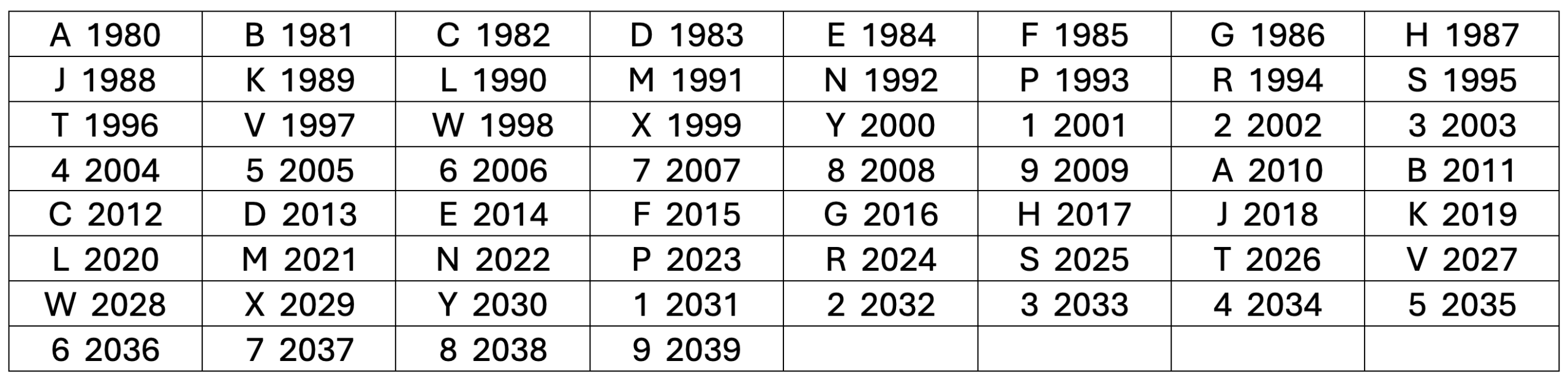
The tenth character reveals the model year of the vehicle. This isn’t always the same as the year the vehicle was built, as model years often start before the calendar year. The code cycles through numbers and letters:
Character 11
This identifies the specific plant where the vehicle was assembled. Each manufacturer uses different codes for their factories.
Characters 12-17
The last six characters form the vehicle’s serial number, which is a unique identifier assigned during production. This section doesn’t follow a specific pattern and is used to distinguish the car from every other one built with the same specs.
How to find
your VIN number
and what it is
Your VIN will be in your V5 document for the car – your ‘log book’
If that isn’t to hand, then it can be found on your car.
Vehicle make dependant – it may be on one of the following places:
It is often at the bottom of the car windscreen seen from outside the car, often on the passenger side of the vehicle.
It may be on the drivers door pillar (door frame / door jamb) as a metal plate, on a sticker, or stamped in to the metal.
Or inside the engine bay possibly near a suspension strut, or stamped in to the floor of the car near the front seat under the carpet.
We rely on the VIN to be able to get accurate wiring diagrams of your car for tracing wiring faults, locating hidden connector blocks and knowing which pin of the connector to look at for a cable we are tracing. There are many other uses for accurate wiring diagrams for use within fault finding, and a very accurate way of getting the vehicle manufacturers wiring diagram is by using the VIN.
The VIN is made up of 17 characters, these characters give further details about the car.
Characters 1-3
The first three characters represent the World Manufacturer Identifier, or WMI. These digits specify the vehicle’s country of origin, manufacturer, and production division. Essentially, this part of the VIN tells you where the vehicle was built and by who.
Characters 4-8
These characters give detailed information about the vehicle:
Type, style, engine specifics, airbags & seatbelts etc, and gearbox / transmission details
Character 9
Used for fraud prevention & validation. It’s generated based on a mathematical formula involving the other VIN characters. Law enforcement, manufacturers, and registration agencies use this to verify the legitimacy of a VIN.
Character 10
The tenth character reveals the model year of the vehicle. This isn’t always the same as the year the vehicle was built, as model years often start before the calendar year. The code cycles through numbers and letters:
Character 11
This identifies the specific plant where the vehicle was assembled. Each manufacturer uses different codes for their factories.
Characters 12-17
The last six characters form the vehicle’s serial number, which is a unique identifier assigned during production. This section doesn’t follow a specific pattern and is used to distinguish the car from every other one built with the same specs.
VIN Number Diagnostics & Vehicle Information
Every vehicle is assigned a unique Vehicle Identification Number (VIN) which contains important information about the vehicle’s build, specifications, and equipment. At Logic Auto Electrical, we use VIN-based diagnostics to help identify vehicle faults, confirm specifications, and ensure accurate repairs.
Using VIN information allows us to access manufacturer-specific data, making diagnosis faster, more accurate, and more efficient.
VIN Number
Diagnostics &
Vehicle Information
Every vehicle is assigned a unique Vehicle Identification Number (VIN) which contains important information about the vehicle’s build, specifications, and equipment. At Logic Auto Electrical, we use VIN-based diagnostics to help identify vehicle faults, confirm specifications, and ensure accurate repairs.
Using VIN information allows us to access manufacturer-specific data, making diagnosis faster, more accurate, and more efficient.
Why VIN Based Diagnostics Are Important
Modern vehicles are highly complex, with multiple control modules communicating across various networks. Using VIN data ensures:
- Accurate diagnostics
- Faster fault finding
- Correct replacement parts
- Proper module programming
- Manufacturer-level information
VIN-based diagnostics help avoid guesswork and reduce diagnostic time.
Why VIN Based
Diagnostics
Are Important
Modern vehicles are highly complex, with multiple control modules communicating across various networks. Using VIN data ensures:
- Accurate diagnostics
- Faster fault finding
- Correct replacement parts
- Proper module programming
- Manufacturer-level information
VIN-based diagnostics help avoid guesswork and reduce diagnostic time.
Jaguar & Land Rover VIN Diagnostics
We specialise in Jaguar and Land Rover VIN diagnostics, including:
- Module identification
- Software level checking
- Vehicle configuration
- Control module compatibility
- Electrical fault identification
VIN-based diagnostics are particularly important on Jaguar Land Rover vehicles, where correct configuration and software levels are critical.
Jaguar & Land Rover
VIN Diagnostics
We specialise in Jaguar and Land Rover VIN diagnostics, including:
- Module identification
- Software level checking
- Vehicle configuration
- Control module compatibility
- Electrical fault identification
VIN-based diagnostics are particularly important on Jaguar Land Rover vehicles, where correct configuration and software levels are critical.
Professional VIN Number Diagnostics
At Logic Auto Electrical, we use professional diagnostic equipment and manufacturer-level tools to access VIN-specific data and information.
This allows us to:
- Diagnose electrical faults faster
- Program control modules correctly
- Confirm vehicle specifications
- Identify software updates
- Access technical documentation
Professional
VIN Number
Diagnostics
At Logic Auto Electrical, we use professional diagnostic equipment and manufacturer-level tools to access VIN-specific data and information.
This allows us to:
- Diagnose electrical faults faster
- Program control modules correctly
- Confirm vehicle specifications
- Identify software updates
- Access technical documentation
Need VIN Based Diagnostics?
If you’re experiencing electrical issues or require vehicle information using your VIN number, get in touch with Logic Auto Electrical today.
We provide professional VIN-based diagnostics for most vehicles.
Need VIN Based
Diagnostics?
If you’re experiencing electrical issues or require vehicle information using your VIN number, get in touch with Logic Auto Electrical today.
We provide professional VIN-based diagnostics for most vehicles.